





Quotex Strategy: Risk Management & Trading Approaches
Last updated: 2026-08-22 · Independent guide (unofficial)
Search for a "Quotex strategy" and you'll find endless promises of secret systems and 90%-win indicators. Here's the honest version: no strategy guarantees profit, and fixed-time options are negative-expectancy for most people. What a good approach actually does is control your losses and keep you disciplined — which is the difference between losing slowly while you learn and blowing up your account. This guide puts risk management first, then covers common approaches neutrally.
Risk management comes first
Before any chart pattern, get these right — they matter more than any "signal":
- Small fixed stakes. Risk a small, consistent amount per trade (many use 1–2% of their balance) so no single loss hurts much.
- Session limits. Decide a maximum number of trades and a stop-loss for the day before you start — then honour it.
- No chasing. Never increase stakes to recover a loss. That's how accounts disappear.
- Journal everything. Track what you did, why, and the result. Your journal is your real edge.
Build a simple plan (step by step)
A plan you'll actually follow beats a clever one you won't:
-
Set a fixed stake
Risk the same small amount per trade (for example 1–2% of your balance). Never increase stakes to 'win back' losses.
-
Cap your session
Decide in advance how many trades — and how big a loss — will make you stop for the day. Then actually stop.
-
Pick a simple setup
Choose one approach (say, trading with the trend on one or two assets) rather than jumping between ideas.
-
Test it on the demo
Run your plan on the free demo across many trades before risking any real money.
-
Journal every trade
Record the asset, reason, result and how you felt. Review weekly and cut what doesn't work.
Common approaches (described honestly)
Trend following
Trading in the direction of the prevailing move (often gauged with moving averages) is a popular starting point. It can keep you on the right side of momentum, but trends reverse without warning and short expiries add noise — it is not a guaranteed edge.
Support & resistance
Some traders watch levels where price has previously turned. These can frame decisions, but levels break regularly, and "obvious" levels are watched by everyone. Use them to manage risk, not to bet bigger.
Indicator confluence (RSI, moving averages)
Waiting for a couple of indicators to "agree" can reduce impulsive trades. Just remember indicators lag and give false signals often; confluence lowers frequency, it doesn't manufacture certainty.
What to avoid
- Martingale and any system that doubles stakes after losses — a normal losing streak can wipe you out.
- Paid "signals" and account managers — a major scam vector, not an edge.
- Trading emotionally — revenge trading after a loss is the fastest way to a bigger one.
- Overtrading — more trades usually means more exposure to the negative expectancy, not more profit.
Practise before you risk real money
Test any approach on the free demo across many trades first. When you do go live, keep stakes tiny, expect losing runs, and treat consistency of process as the goal — not a target profit. If you ever feel you "need" to trade to make money back, stop. For the bigger picture, read is Quotex safe? and the complete trading guide.
Practise your plan risk-free
The button opens the official Quotex site. Test on the demo before any real stakes.
Frequently asked questions
What is the best Quotex strategy?
There is no 'best' strategy that reliably makes money — anyone claiming otherwise is misleading you. The approach that helps most is strict risk management: small fixed stakes, session limits, one simple setup, demo testing and journaling. That controls losses; it doesn't guarantee profits.
Does any strategy guarantee wins on Quotex?
No. Fixed-time options are negative-expectancy for most traders, and no indicator, pattern or 'system' can predict the market reliably. Strategy is about managing risk and staying disciplined, not about certainty.
Is the martingale strategy safe on Quotex?
No — it's dangerous. Doubling your stake after each loss can blow up your balance quickly during a losing streak, which happens more often than people expect. Avoid martingale and any approach that scales up losses.
What indicators do traders use on Quotex?
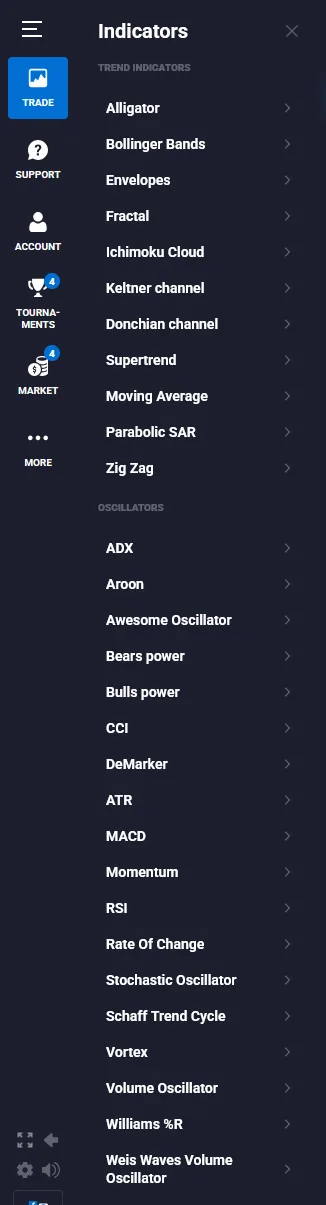
Commonly discussed tools include moving averages, RSI and support/resistance levels. They can help you frame a view and manage risk, but they lag or fail regularly and none is a crystal ball. Use them as part of a disciplined process, not as a signal to bet bigger.
How much should I risk per trade?
A common guideline is a small, fixed percentage (e.g. 1–2% of your balance) per trade, so no single loss — or losing streak — can seriously damage your account. The exact number is personal, but 'small and consistent' beats 'big and emotional'.
Should I use paid signals or 'account managers'?
No. Paid signal sellers and anyone offering to 'manage' or 'guarantee' your account are a major scam risk and are not the broker. Keep control of your own account and ignore guaranteed-profit promises entirely.
How do I actually get better?
Practise on the demo, keep stakes tiny when you go live, journal and review your trades, and focus on process over outcome. Accept that losses are part of it, and never trade money you can't afford to lose.
Can I make a living trading Quotex?
For the overwhelming majority of people, no. Most retail accounts lose money, and treating high-risk fixed-time options as income is how people get hurt. Approach it as high-risk speculation with money you can afford to lose.